




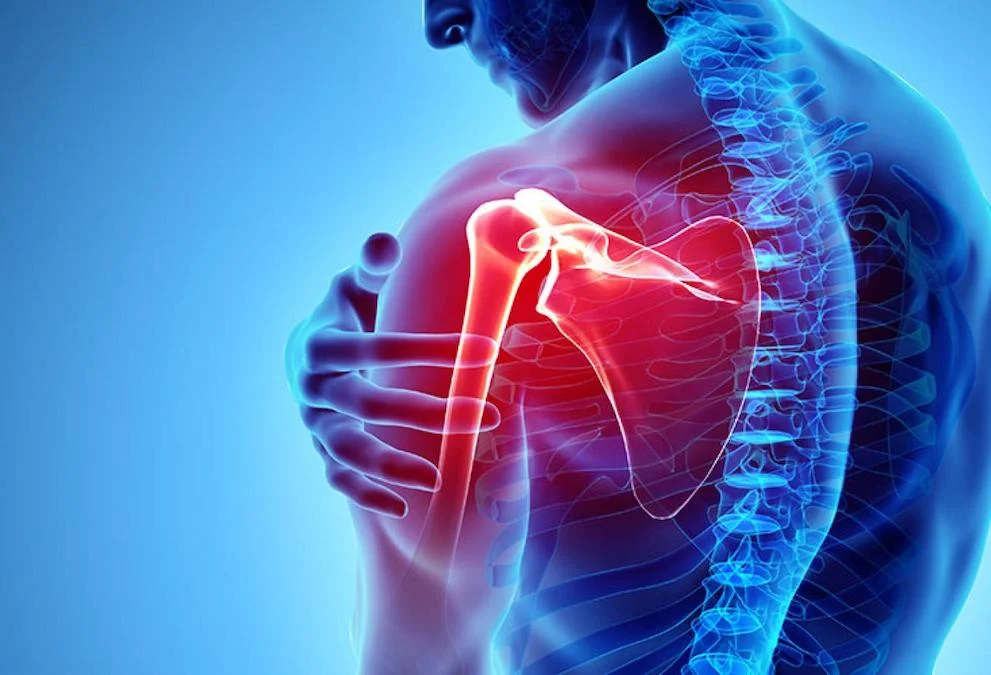
Shoulder pain can occur due to tendinitis, tendon tears, osteoarthritis, and impingement syndrome, among many other causes. It is possible for multiple pathologies to coexist due to the exceptional complexity of the shoulder’s anatomy.
The shoulder consists of the following three bones:
- Humerus
- Scapula
- Clavicle
The ball of the humerus “fits” into a shallow socket called the glenoid (part of the scapula). In the scapula, there are strong ligaments and tendons that keep the ball centered in the socket, as well as the muscles and tendons of the rotator cuff, which allow the lifting and rotation of the arm. Any pathology or damage to this part of the anatomy can cause shoulder pain.
What can cause shoulder pain?
Shoulder pain is an extremely common problem. There are various potential causes.
The most frequent cause of shoulder pain is damage to the so-called rotator cuff. There are four rotator cuff tendons that are essential for shoulder movement (the supraspinatus, the infraspinatus, the subscapularis, and the teres minor).
There are three main types of rotator cuff pathology:
- Tendinitis (inflammation of the tendons)
- Bursitis – inflammation of the bursa – (a fluid-filled sac-cushion that protects and lubricates the tendons connecting the shoulder muscles to the humerus bone). Bursitis usually coexists with tendinitis.
- Rotator cuff tears – these occur when the rotator cuff tendons detach from the bone.
These problems usually cause painful symptoms when performing activities such as lifting the arm above the head, or during sports and manual labor.
Additionally, there is usually intense shoulder pain from a rotator cuff tear, which is worse or intensifies at night. Therefore, it is not uncommon for individuals suffering from rotator cuff tendinitis or a rotator cuff tear to be unable to sleep on the affected shoulder.
Rotator cuff problems can also present with restricted active motion. Consequently, the shoulder is often stiff. If the physician lifts the arm, the shoulder will move normally.
Other common causes of shoulder pain include:
- Frozen Shoulder – a very common diagnosis also termed adhesive capsulitis. Frozen shoulder leads to joint stiffness and continuous severe pain with all daily activities and movements. With a frozen shoulder, there is a very significant loss of active range of motion as well as passive range of motion, during which the physician cannot improve shoulder movement even when they move the arm.
- Calcific Tendinitis – is the condition in which calcium crystals deposit within the tendons. This condition usually causes very severe and unbearable shoulder pain, which is worse at night and aggravates with any movement.
- Biceps Tendinitis – pain at the front of the shoulder is related to inflammation of the biceps tendon. Patients usually feel pain at the front of the shoulder, and this moves downward or upward from the biceps muscle. This becomes worse when lifting the arm above the head. This can sometimes cause a click when the entire arm is rotated.
- Biceps Tendon Rupture – occurs during an injury. Sometimes, a sudden loud sound may be heard, along with worsening of the pain, bruising, and swelling higher up in the arm near the humerus or at a point right above the elbow. This differentiates between a proximal and a peripheral biceps tendon tear.
- SLAP Tear – an anterior to posterior tear of the superior labrum. This specific type of labral tear in the shoulder can occur from a simple fall onto an outstretched hand, in throwing athletes, or in patients engaged in heavy, repetitive overhead activities. These symptoms can include deep shoulder pain, a sensation of instability, or catching with movement.
- Shoulder Arthritis – the patient usually describes a deep shoulder pain at the front of the shoulder, along with stiffness. There is generally a loss of active and passive motion, and sometimes it can be confused with a frozen shoulder in the absence of an X-ray.
- Acromioclavicular Joint Arthritis – the pain is felt at the top of the shoulder and the patient usually complains of pain during palpation of the joint.
- Acromioclavicular Joint Dislocation – these patients usually have a history of trauma caused by a fall onto that shoulder. Depending on the severity and the ligaments that may be involved, a bump may form over the shoulder due to the separation of the scapula from the clavicle.
- Distal Clavicle Osteolysis – is a condition that causes acute pain in the clavicle. It is observed most frequently in weightlifters and individuals who repeatedly lift or carry heavy objects over the shoulder.
- Shoulder Instability – instability is a common problem indicating a loose joint. This can be caused by injury, a shoulder dislocation, or overuse. Some individuals have loose ligaments, which lead to chronic instability or multidirectional instability. These patients often describe a sensation of numbness in the arm and have an excessive range of motion in the shoulder.
- Shoulder Dislocation – an injury that occurs when the humerus detaches from the scapula. If someone dislocates their shoulder, the normal ligaments will undergo a tear and the shoulder will have a tendency to feel unstable or pop back out of the joint.
- Shoulder Impingement – a very common cause of shoulder pain, which frequently occurs after repetitive overhead arm movements. All the tendons along with the bursa come into friction between the shoulder bones and render any shoulder movement painful. Various activities and rotational movements of the arm can worsen the symptoms.
- Fractures – e.g., clavicle fracture, humerus fracture, or scapula fracture.
Neck pain can sometimes radiate peripherally and be confused with or mimic shoulder pain. A comprehensive neurological examination must be performed in every case.
Heart Attack: Pain in the left arm or shoulder can be a symptom of an impending heart attack or heart disease.
Examinations performed when someone suffers from shoulder pain
Given that there are many potential causes, a detailed review of symptoms, a thorough clinical examination, and imaging tests are imperative to make a correct and accurate diagnosis.
After taking a detailed history, Mr. Polyzois will perform a meticulous examination of the shoulder. He may also examine other areas of your body, such as the neck or the spine.
In addition to the clinical examination, the physician will send the patient for imaging tests to confirm the diagnosis:
- Plain X-rays: These can visualize if there is a fracture in the bone, as well as calcium deposits or osteophytes that might potentially indicate the presence of osteoarthritis.
- Ultrasound: A simple, non-invasive examination and a reliable, dynamic diagnostic tool for evaluating the shoulder and all its structures.
- CT Scan: Can evaluate the architecture of joints and bones in cases of severe deforming arthritis or fractures.
- MRI: An MRI of the shoulder is the imaging examination of choice and can provide detailed and accurate visualization of bones and all soft tissues, ligaments, tendons, and muscles around the shoulder. It can, for example, provide information regarding the location, size, shape, and degree of muscle atrophy of a rotator cuff tear.
Management of Shoulder Pain
Your treatment depends fully on the diagnosis. The most important thing is for the physician to reach the correct diagnosis.
- Rest: The first treatment for many conditions is resting the joint to allow inflammation to subside. It is important not to prolong joint immobilization because this can cause a frozen shoulder.
- Ice Therapy: This can be used to reduce edema and pain after an injury or overuse.
- Physical Therapy: Physical therapy is of paramount importance in almost all orthopedic conditions, including shoulder conditions. Experienced physical therapists use different treatments to improve strength, restore mobility, and help people return to their pre-injury activity levels. Treatments include deep massage, acupuncture, and specific exercises for stretching, rehabilitating, and strengthening specific muscle groups.
- Medications: The most common medications are non-steroidal anti-inflammatory drugs, cortisone injections, and PRP.
- Non-steroidal Anti-inflammatory Drugs (NSAIDs): Used to treat shoulder problems such as arthritis, bursitis, and tendinitis. It is important to use them only for a short period of time, as they can also be associated with risks. Specifically, individuals suffering from hypertension, asthma, a history of kidney problems, liver disease, or stomach ulcers should not be prescribed NSAIDs.
- Cortisone and Platelet-Rich Plasma (PRP) Injections: The doctor will give you a combination of steroids with local anesthetic and platelet injections. The logic behind the injections is not only to relieve pain, but to help the patient perform physical therapy more easily and bring the shoulder back to its normal function and strength.
In certain cases, surgery will have to be performed if conservative measures have failed due to the condition or an injury of the shoulder that is very severe from the outset.
Mr. Polyzois has performed a very large volume of arthroscopic shoulder surgeries with rapid and reliable restoration. Apart from fractures, instability with significant bone loss, or severe osteoarthritis requiring minimally invasive arthroplasty, all other conditions around the shoulder can be managed via arthroscopic surgery.
When should I see the specialist for my shoulder pain?
- Inability to carry objects or use the arm
- Shoulder pain that appears (or worsens) at night or during rest
- Injury causing joint deformity
- Shoulder pain that persists beyond a few days
- Inability to lift and move the arm
- Edema or significant bruising around the shoulder
- Signs of infection (fever, skin redness, and increased temperature)
- Any other unusual symptoms related to the shoulder such as abdominal pain, difficulty breathing, or chest pain.
Prevention of Shoulder Pain
Because most cases of shoulder pain are caused by overuse, the best treatment is prevention. It is important to avoid or modify the activities that cause the problem. Underlying conditions, such as incorrect posture or poor technique in sports or work, must be corrected.
Apply these basic rules when performing activities in the workplace, the office, and during sports:
- Start slowly at first and gradually increase your activity level.
- Use reduced force and limited repetitions in the beginning.
- Stop if unusual pain appears.
- Correct your technique.
- Visit us for an evaluation of the problem.
- Visit a specialized physical therapist.
Call us for information and to schedule an appointment.