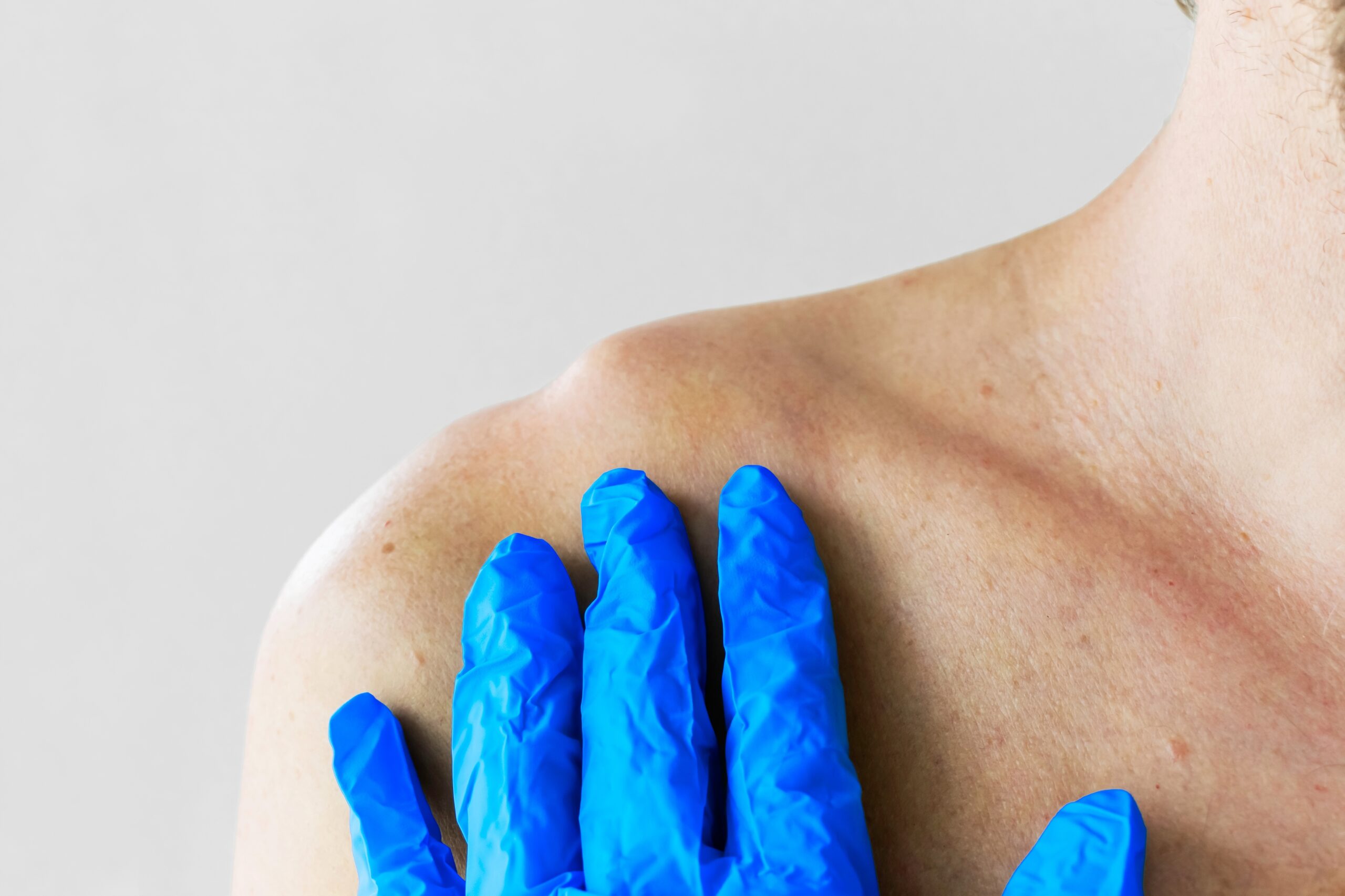
Κάταγμα Κλείδας

Clavicle Fracture

ΠΕΡΙΕΧΟΜΕΝΑ

What is a clavicle fracture?

A clavicle fracture occurs when the bone cracks or breaks.

The clavicle (collarbone) is the bone located between the sternum (breastbone) and the scapula (shoulder blade).

Anatomically, the clavicle is located right above and protects very important nerves (brachial plexus) and vital blood vessels (subclavian vessels). However, these are rarely injured when a fracture occurs.

The clavicle is one of the bones that make up the shoulder, and the only one that connects the arm and upper extremity to the rest of the body and skeleton. More specifically, there are two clavicles, which are long, thin, S-shaped bones with a wavy form located just beneath the skin (subcutaneous).

Clavicle fractures are quite common and occur in people of all ages. Most fractures happen in the middle section of the bone. Occasionally, the bone will break where it connects to the chest or the shoulder blade.

A clavicle fracture is quite common, accounting for about 5% of all fractures in adults.

Ο μόνος Ορθοπαιδικός στην Ελλάδα στην χειρουργική ώμου και άνω άκρου με προϋπηρεσία μόνιμης διευθυντικής θέσης (substantive Consultant ) για 10 συναπτά έτη στην Μεγάλη Βρετανία

Types of Clavicle Fractures

Clavicle fractures vary. The bone may break slightly in one spot or shatter into many pieces (comminuted fracture). The broken bone pieces may be in close contact and well-aligned (non-displaced fracture), or they may be far out of their position with no contact at all (displaced fracture).

It is also worth noting that the clavicle is a bone very close to the skin surface, and thus any fracture is likely to cause a blood supply problem to the superficial (surface) skin tissues, the subcutaneous tissue, and adjacent soft tissues.

In some cases, we may have an open clavicle fracture (where the broken part of the bone is in communication with the environment).

Most clavicle fractures occur from a fall onto the shoulder or when an outstretched hand exerts such pressure on the bone that it breaks. A clavicle fracture is extremely painful and makes any movement of the arm difficult.

Many clavicle fractures can be managed by wearing an arm sling to keep the arm and shoulder immobilized until the bone “knits.” With some clavicle fractures, however, the bone pieces have either displaced far from their original position, are in multiple pieces, or the skin over the bone is in poor condition due to the pressure from the broken bone.

For these more complex fractures, a small surgery may be required for Mr. Polyzois to restore the bone to its original anatomical position.

Symptoms of a Clavicle Fracture

A clavicle breaks when force or pressure forces it to. Common causes are:

  • Injury and a fall with an outstretched hand, such as during sports or manual labor.
  • Direct collision – a blow to the clavicle, such as in a car accident.
  • Falling onto the clavicle from a two-wheeled vehicle at speed.

A clavicle fracture can be particularly painful and can make moving the arm difficult. Other symptoms may include:

  • Drooping of the shoulder downward and forward
  • Inability to lift the shoulder due to pain
  • A grinding sensation (crepitus) when the patient attempts to raise the arm
  • Deformity of the clavicle’s shape around the fracture
  • Bruising, swelling, and severe tenderness over the bone

Rare but serious complications include infection from an open fracture, damage to the underlying nerves and vessels, as well as multiple fractures and severe injuries to the shoulder and scapula, which create what is known as a floating shoulder.

Diagnosis and Evaluation of a Clavicle Fracture

Plain X-rays are essential to identify the exact location of the fracture and to show more about the nature of the fracture.

Mr. Polyzois may also send the patient for further X-rays, such as of the entire shoulder, to check for additional injuries.

If multiple injuries coexist, a Computed Tomography (CT) scan with three-dimensional (3D) imaging is the modality of choice for clarity and detail, allowing for better preoperative planning or a comprehensive view of the fracture.

Clavicle Fracture Treatment

Clavicle fracture treatment can be performed either conservatively or surgically. More specifically:

Conservative treatment

If the broken bone ends have not displaced significantly from their position, surgery may not be necessary. Many fractures can thus achieve union, meaning they “knit” satisfactorily.

  • Pharmacotherapy, meaning the administration of simple analgesics and avoidance of NSAIDs.
  • Ice therapy
  • Immobilization

More specifically, the affected limb is immobilized in a special arm sling for 6 weeks. A thorough X-ray follow-up is performed every 2-3 weeks, depending on the type of fracture, followed by a specific, individualized exercise program with a specialized physical therapist, always under the guidance and close monitoring of Mr. Polyzois and his team. These exercises will help prevent stiffness and weakness.

The patient gradually begins more intense strengthening exercises once the clavicle fracture has completely healed. After the bone has healed, the individual is able to gradually return to normal activities.

Complete union can take 3 to 6 months in some cases, with a small percentage of clavicle fractures failing to “knit” (nonunion).

In other cases, the bone does not heal properly or in the correct anatomical position (malunion), resulting in aesthetic deformity in the area and pain. In this case, a significant reduction in clavicle length is usually observed (over 2.5 cm), along with weakness and reduced endurance during athletic or manual activities.

In the above scenarios, Mr. Polyzois will advise surgical treatment with a corrective procedure to fully restore the upper limb’s range of motion and strength.

Surgical treatment

If the broken bone ends have displaced significantly from their position, Mr. Polyzois will recommend surgery.

The surgery aims for anatomical reduction and union of the fracture, as well as a full return to normalcy through shoulder range of motion and strengthening exercises.

Open reduction and internal fixation (ORIF). This is the method of choice most commonly used to treat clavicle fractures. The bone pieces are held in their anatomical position with special hardware.

Mr. Polyzois uses only the best, most reliable, and most modern materials, specifically the latest-generation anatomical plates and screws. They consist of a titanium alloy, are specially designed for each patient’s bone anatomy, and are lightweight yet extremely powerful materials. In Mr. Polyzois’s hands, the operation lasts about 45 minutes, and the patient is discharged a few hours later.

The doctor uses a minimally invasive method, and the surgery is bloodless with minimal postoperative pain.

Therefore, surgical restoration of the clavicle offers the following important advantages:

  • Faster return to work, sports, and daily activities
  • Minimal pain
  • Maximum probability of the fracture knitting in its correct anatomical position, and of course, faster and more reliable fracture union

The plates and screws do not necessarily have to be removed after the bone heals, unless they cause significant discomfort with daily activities. Problems with the hardware are not common, but some patients find, for example, that seatbelts and backpacks can irritate the clavicle area. If this happens, the materials can easily be removed approximately 4-12 months after the surgery.

The materials used by our team are also fully compatible with the free use of Magnetic Resonance Imaging (MRI) in the shoulder and upper limb area without any hesitation.

Rehabilitation and Recovery

Before discharge, Mr. Polyzois will discuss everything in detail with the patient and provide specific postoperative instructions. The patient will be monitored by a specialized physical therapist, following an individualized rehabilitation protocol. Our patients fully return to all their activities within 3-4 weeks.

It is worth noting that the patient can actively use their wrist and elbow immediately after the surgery and can manage daily self-care normally.

Generally, recovery programs typically begin with gentle passive and then active shoulder movement exercises, gradually increasing the range. The experienced physical therapist, always in regular consultation with Mr. Polyzois, will gradually add strengthening exercises to the program as the fracture heals. Naturally, this is adapted and individualized according to the needs of each patient, the nature of the fracture, and the specific surgical method followed.

Although it is a process that requires discipline from the patient, following the specific physical therapy program to the letter is perhaps the most important factor for a full return to all the activities each patient enjoyed before the clavicle fracture.

Η κIνηση εIναι ζωH!

Επικοινωνήστε με τον γιατρό για εξειδικευμένη ορθοπαιδική φροντίδα, προσαρμοσμένη στις ανάγκες σας

Συχνές ερωτήσεις

How common is a clavicle fracture in children and adolescents?

It is particularly common in younger ages, mainly due to increased activity and sports.

Can a clavicle fracture go unnoticed?

In non-displaced fractures, it can be mistaken for a simple injury. Nevertheless, pain, swelling in the area, as well as difficulty moving the shoulder usually lead to a diagnosis.

Can I sleep normally with a clavicle fracture?

Sleeping in a semi-reclined position or on your back with support is usually recommended to reduce pressure on the area.

Are there long-term effects after a clavicle fracture?

In most cases, no, but in some patients, a shortening of the clavicle may remain, and after conservative treatment, a weakness in the endurance of the shoulder area may persist.

When can I drive after a clavicle fracture?

Driving is allowed only when the patient has adequate control and strength in the hand and is pain-free, which is evaluated by the doctor. Usually, this happens at least after 3 weeks.

When should a clavicle fracture be operated on?

In most cases, a clavicle fracture can be treated conservatively. In any case, the decision is individualized according to the age and activities of each patient. Nonetheless, surgical treatment is recommended for displaced fractures or fractures with shortening of more than 2 centimeters.