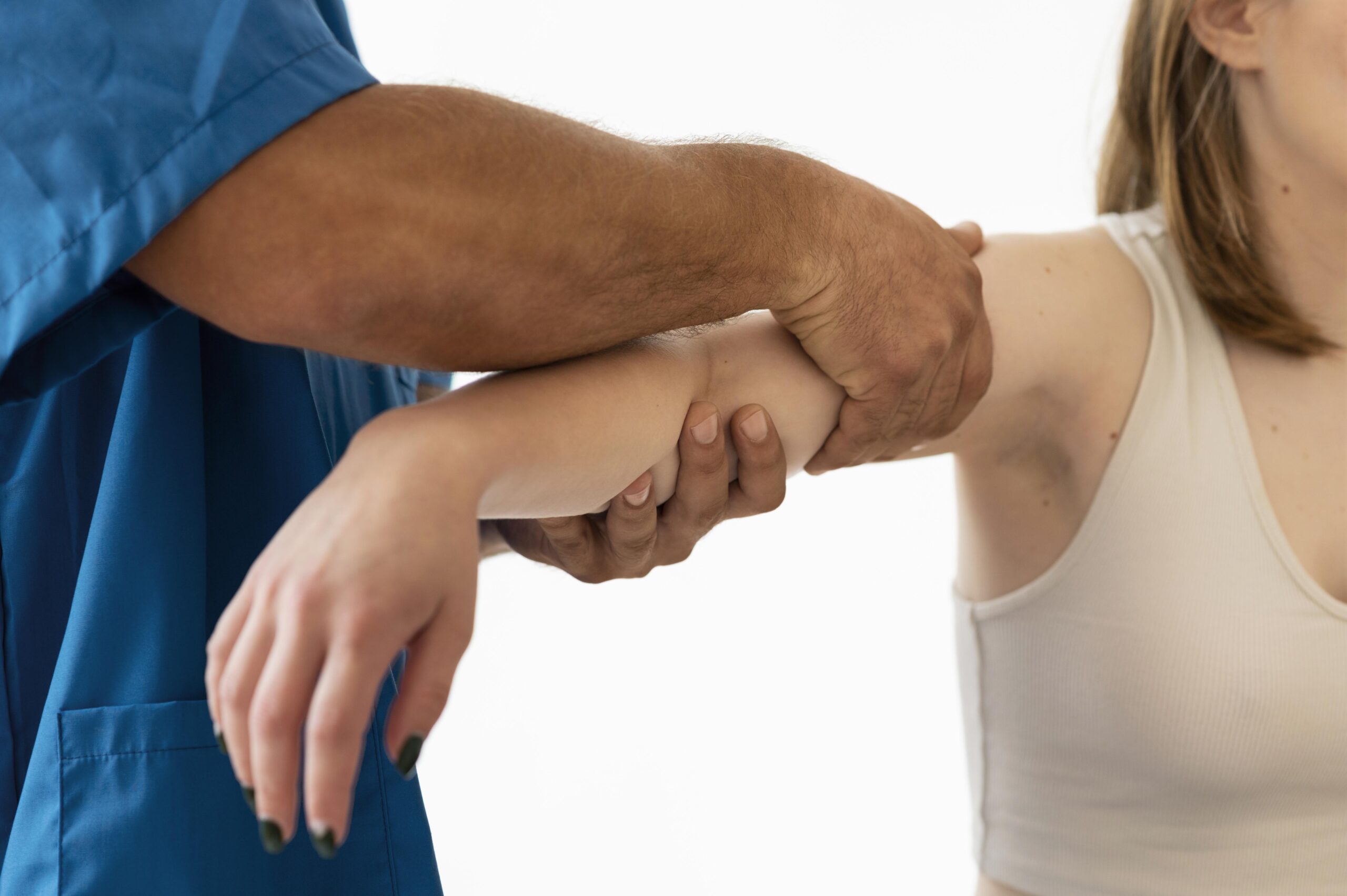
Management: Conservative Treatment vs. Surgical Repair
The dilemma between conservative and surgical management can only be resolved based on scientific data. The international orthopaedic literature (and numerous multicentre studies) demonstrates an inexorable truth:
The lower the age at which the first dislocation occurs, the geometrically greater the probability that the patient will suffer a second dislocation. For a young, active patient under 20–22 years of age who plays sports, the probability of dislocating the shoulder again, regardless of how good their physiotherapy is, approaches 80–100%. Each new dislocation further destroys the tissues, “eats away at” the bone, and increases the risk of future, painful arthritis.
Conservative Treatment
We usually recommend it for older patients (over 40–45 years of age), with a low level of athletic/manual activity, provided there are no tendon tears, or for patients with atraumatic, generalised laxity where the problem is the constitution of the tissues.
The protocol includes:
- Immobilisation in a special sling with the arm often in a neutral or slight external rotation for 2–4 weeks, to allow an initial healing of the torn tissues.
- Cryotherapy and Non-Steroidal Anti-Inflammatory Drugs (NSAIDs) for pain control.
- Long-term, aggressive Physiotherapy programme. The goal here is dynamic stabilisation: since the ligaments have stretched out, we train the rotator cuff and scapular muscles to “grip” and keep the joint in place.
The Definitive Surgical Solution: Arthroscopic Shoulder Stabilisation
Provided that the data (age, sports activity, injuries) argue in favour of surgery, my advice is clear: Do not delay. Do not allow your joint to be destroyed with every new dislocation.
The surgical method I apply offers a permanent, reliable, and definitive solution, following the strict GIRFT philosophy (Get It Right First Time). The method of choice is Shoulder Arthroscopy (Arthroscopic Bankart Repair / Stabilisation).
Having a vast volume of cases (high-volume surgeon) and the experience of thousands of operations, arthroscopy in the hands of our team is minimally invasive, bloodless, and extremely safe.
- The Procedure: Through 3 microscopic openings (4 millimetres), I insert the High Definition camera and the state-of-the-art fine instruments into the shoulder. I identify the exact damage to the labrum.
- The Repair: Using special, latest-generation bioabsorbable anchors (often knotless anchors) that are placed inside the glenoid, I fix (suture) the torn labrum and the ligaments back into their anatomical position. In parallel, I plicate (tighten) the capsule to “tighten” the shoulder. If there is a Hill-Sachs lesion, I may apply the Remplissage technique (filling the bone defect with a tendon).
- The Time and the Anaesthesia: The operation lasts about 30–45 minutes. Our specialised anaesthesiologist applies local (regional) anaesthesia (interscalene block) which guarantees that you will not feel any pain for the next 12–24 hours. Light sedation or a short general anaesthesia is applied so that you are completely comfortable.
- The Recovery: No hospitalisation is required. The patient is discharged and returns home on the very same day. The materials used are 100% biocompatible, integrate with the bone, and are not rejected.
Rehabilitation and Physiotherapy: The Return to Movement
The surgical operation is only half the journey. The other 50% of success — the recovery of full range of motion, strength, and confidence in the shoulder — belongs to strict and structured rehabilitation. I am categorical about this: the seamless cooperation of doctor, patient, and physiotherapist is the cornerstone.
Through our extensive network of specialised physiotherapists throughout Greece, we apply a personalised protocol, which includes:
- Weeks 1–4 (Protection): The shoulder is protected in a special sling. External rotation is forbidden in order to protect the repair (the anchors “bond” with the bone). Free movement of the wrist and elbow and mild passive exercises (pendulum) are allowed. You can take care of yourself from Day 1.
- Weeks 4–8 (Mobilisation): The sling is removed permanently. Passive and active-assisted range of motion begins. The goal is to recover elasticity without putting pressure on the sutures.
- Weeks 8–12 (Strengthening): Isometric and progressive strengthening of the rotator cuff muscles (use of resistance bands) and stabilisation of the scapula begins. You now have full, comfortable movement overhead.
- Months 4–6 (Return to Sport): The final stage. It includes plyometric exercises, proprioception, and special training depending on the sport. At 4 to 6 months, full and unrestricted participation is allowed even in the most demanding contact sports (e.g. rugby, wrestling) with complete safety.
Meet the Doctor: Dr. Ioannis Polyzois
The treatment of dislocation and the delicate art of arthroscopic stabilisation do not allow for amateurism. They require deep knowledge of anatomy and absolute specialisation. As an Orthopaedic Surgeon with exclusive, targeted specialisation in the conditions, complex trauma, and sports medicine of the shoulder and upper limb, my primary goal is to offer you a definitive, safe, and scientifically documented solution.
Having served as a permanent Consultant in Orthopaedics in the National Health Service of Great Britain (NHS) for more than 10 years, I have managed, at the largest trauma centres in London, the most complex and difficult cases of shoulder instability. My extensive years of further training (fellowships) at the top centres of arthroscopic surgery worldwide enable me to apply the most advanced international techniques in Greece.
To date, I have performed more than 9,000 arthroscopic and open surgical operations. This vast, documented surgical experience — which is reflected in the trust and the hundreds of excellent reviews from our patients — makes me the most competent doctor for the successful execution of such demanding operations, from a simple Bankart repair to complex bone reconstructions.
Every patient is unique, which is why our medical approach is always entirely personalised. We are here to listen to your problem, to resolve every question with honesty, and to design together your return to action.
Cost and Price: Arthroscopic Shoulder Stabilisation
One of the first and most reasonable questions of patients, especially of young people and their families, concerns the financial aspect of the surgical treatment. It is important to understand that shoulder arthroscopy is a medical procedure of high technological specialisation. As such, it is not offered in the form of standardised “packages”.
The final price is shaped strictly on the basis of the needs of your particular joint. The main factors that determine the final cost are:
- The Extent of the Damage: A simple stabilisation with two bioabsorbable anchors has a different cost from an extensive tear that requires four anchors, or a concomitant tendon repair (e.g. Remplissage).
- The Cutting-Edge Materials: At our practice, we do not compromise on quality. We use exclusively certified, top materials and ultra-high-strength anchors (usually from America or Switzerland), which guarantee the longevity of the result.
- The Hospital of Choice: The expenses of the day clinic (one-day surgery), the use of the High-Definition equipment, and the medication.
- Your Insurance Coverage: The possibility of using the public insurance fund (EOPYY) or your private insurance policy (which often covers 100% of the operation).
Our commitment is to absolute transparency. The exact, honest, and final cost, without any hidden charges whatsoever, is calculated and discussed in detail with you exclusively after the scheduling of an appointment, the clinical assessment, and the study of your MRI/CT examinations by the doctor.
Movement is life!
The fear of instability and the pain of dislocation should not deprive you of the ability to participate actively in life, sport, and the activities you love. Modern orthopaedics has the knowledge and the minimally invasive technology to safeguard your joint.
Contact the doctor today to schedule a thorough diagnostic appointment. We will investigate your data with scientific accuracy, we will resolve every question of yours with honesty, and we will design the most specialised and permanent orthopaedic solution, fully tailored to your needs.