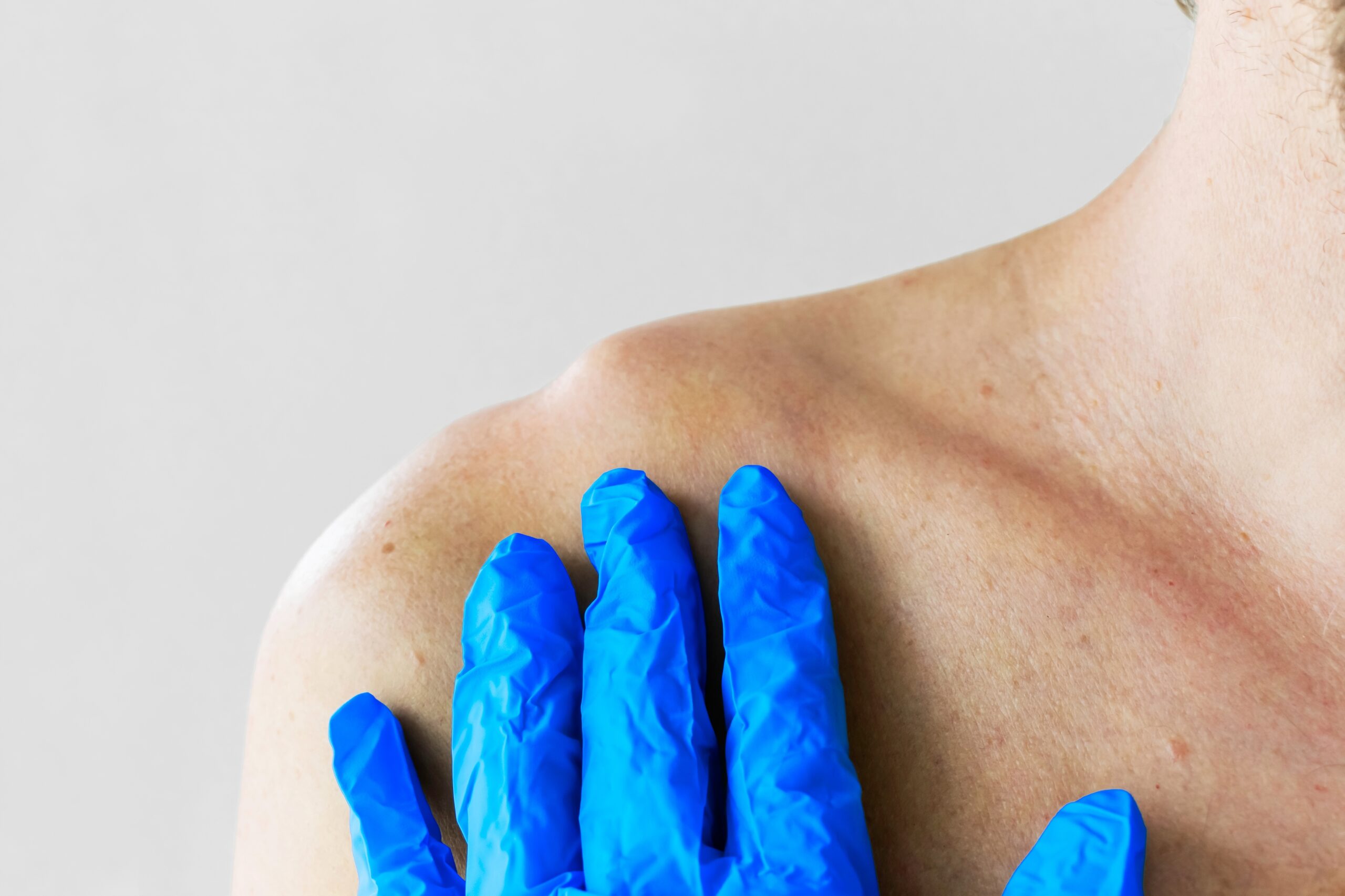
Symptoms of a Clavicle Fracture
A clavicle breaks when force or pressure forces it to. Common causes are:
- Injury and a fall with an outstretched hand, such as during sports or manual labor.
- Direct collision – a blow to the clavicle, such as in a car accident.
- Falling onto the clavicle from a two-wheeled vehicle at speed.
A clavicle fracture can be particularly painful and can make moving the arm difficult. Other symptoms may include:
- Drooping of the shoulder downward and forward
- Inability to lift the shoulder due to pain
- A grinding sensation (crepitus) when the patient attempts to raise the arm
- Deformity of the clavicle’s shape around the fracture
- Bruising, swelling, and severe tenderness over the bone
Rare but serious complications include infection from an open fracture, damage to the underlying nerves and vessels, as well as multiple fractures and severe injuries to the shoulder and scapula, which create what is known as a floating shoulder.
Diagnosis and Evaluation of a Clavicle Fracture
Plain X-rays are essential to identify the exact location of the fracture and to show more about the nature of the fracture.
Mr. Polyzois may also send the patient for further X-rays, such as of the entire shoulder, to check for additional injuries.
If multiple injuries coexist, a Computed Tomography (CT) scan with three-dimensional (3D) imaging is the modality of choice for clarity and detail, allowing for better preoperative planning or a comprehensive view of the fracture.
Clavicle Fracture Treatment
Clavicle fracture treatment can be performed either conservatively or surgically. More specifically:
Conservative treatment
If the broken bone ends have not displaced significantly from their position, surgery may not be necessary. Many fractures can thus achieve union, meaning they “knit” satisfactorily.
- Pharmacotherapy, meaning the administration of simple analgesics and avoidance of NSAIDs.
- Ice therapy
- Immobilization
More specifically, the affected limb is immobilized in a special arm sling for 6 weeks. A thorough X-ray follow-up is performed every 2-3 weeks, depending on the type of fracture, followed by a specific, individualized exercise program with a specialized physical therapist, always under the guidance and close monitoring of Mr. Polyzois and his team. These exercises will help prevent stiffness and weakness.
The patient gradually begins more intense strengthening exercises once the clavicle fracture has completely healed. After the bone has healed, the individual is able to gradually return to normal activities.
Complete union can take 3 to 6 months in some cases, with a small percentage of clavicle fractures failing to “knit” (nonunion).
In other cases, the bone does not heal properly or in the correct anatomical position (malunion), resulting in aesthetic deformity in the area and pain. In this case, a significant reduction in clavicle length is usually observed (over 2.5 cm), along with weakness and reduced endurance during athletic or manual activities.
In the above scenarios, Mr. Polyzois will advise surgical treatment with a corrective procedure to fully restore the upper limb’s range of motion and strength.
Surgical treatment
If the broken bone ends have displaced significantly from their position, Mr. Polyzois will recommend surgery.
The surgery aims for anatomical reduction and union of the fracture, as well as a full return to normalcy through shoulder range of motion and strengthening exercises.
Open reduction and internal fixation (ORIF). This is the method of choice most commonly used to treat clavicle fractures. The bone pieces are held in their anatomical position with special hardware.
Mr. Polyzois uses only the best, most reliable, and most modern materials, specifically the latest-generation anatomical plates and screws. They consist of a titanium alloy, are specially designed for each patient’s bone anatomy, and are lightweight yet extremely powerful materials. In Mr. Polyzois’s hands, the operation lasts about 45 minutes, and the patient is discharged a few hours later.
The doctor uses a minimally invasive method, and the surgery is bloodless with minimal postoperative pain.
Therefore, surgical restoration of the clavicle offers the following important advantages:
- Faster return to work, sports, and daily activities
- Minimal pain
- Maximum probability of the fracture knitting in its correct anatomical position, and of course, faster and more reliable fracture union
The plates and screws do not necessarily have to be removed after the bone heals, unless they cause significant discomfort with daily activities. Problems with the hardware are not common, but some patients find, for example, that seatbelts and backpacks can irritate the clavicle area. If this happens, the materials can easily be removed approximately 4-12 months after the surgery.
The materials used by our team are also fully compatible with the free use of Magnetic Resonance Imaging (MRI) in the shoulder and upper limb area without any hesitation.