Olecranon Bursitis

ΠΕΡΙΕΧΟΜΕΝΑ

The elbow joint is a mechanical marvel of the human body, allowing us to perform a vast range of movements, from lifting weights to the most delicate and precise micro-movements of our hands. However, due to its location and minimal coverage by muscle tissue or fat, the back of the elbow is extremely exposed to injuries, daily friction, and strain. One of the most frequent and characteristic conditions appearing in this area is olecranon bursitis. Olecranon bursitis is a condition that can cause anything from a simple, painless enlargement to an exceptionally acute, agonizing pain that completely restricts the functionality of the arm. In the detailed article that follows, we will examine in depth what exactly this condition is, how it is created, whom it affects, and what the most modern and definitive medical solutions are for its management.

Ο μόνος Ορθοπαιδικός στην Ελλάδα στην χειρουργική ώμου και άνω άκρου με προϋπηρεσία μόνιμης διευθυντικής θέσης (substantive Consultant ) για 10 συναπτά έτη στην Μεγάλη Βρετανία

What is olecranon bursitis?

To fully understand olecranon bursitis, it is necessary to know the anatomy of the region. At the back of the elbow, there is a bone that protrudes and which we can all palpate easily: this is called the olecranon.

All major joints in the body (such as the shoulders, knees, hips, and elbows) are surrounded by specific anatomical formations called bursae. A bursa is essentially a very thin, closed sac or “cushion” which contains a minimal amount of lubricating fluid (synovial fluid). The main function of this bursa is to act as a shock absorber, facilitating the smooth gliding of the skin over the underlying bone of the olecranon during flexion and extension of the elbow, reducing friction to a minimum.

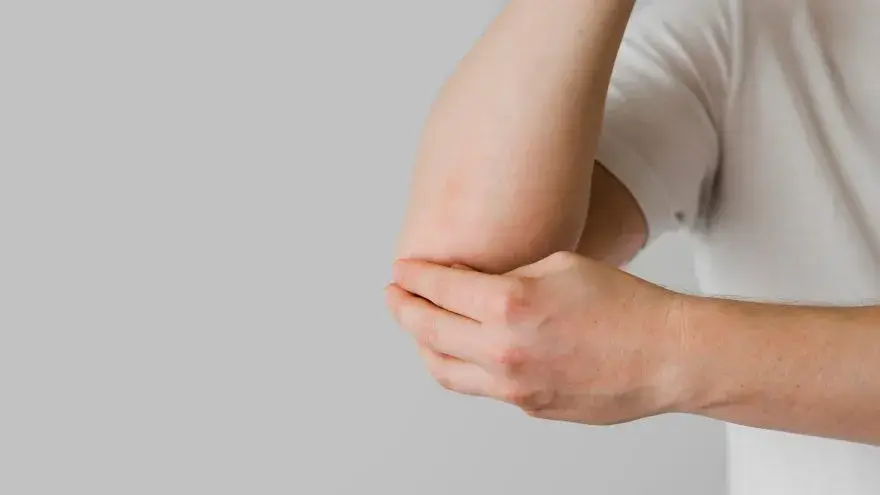
In its normal state, the olecranon bursa is completely flat and is not even noticed during palpation. However, bursitis occurs when this bursa is irritated by overuse, injured directly, or contaminated during an infection. The inflammation (irritation) forces the cells of the bursa to produce an excessive amount of fluid. As the fluid accumulates and cannot escape, the bursa swells outward, creating a characteristic swelling at the back of the elbow, which can often take the size of a small golf ball.

Olecranon bursitis is an enlargement at the back of the elbow between the bone and the skin surface, which can be either entirely painless (in initial or chronic stages) or exceptionally painful (in acute or infectious conditions). The pain of bursitis can come on suddenly or accumulate gradually over the passage of time.

Causes and Types of Elbow Bursitis

Olecranon bursitis is medically distinguished into two large, fundamental categories, the differentiation of which is absolutely critical for correct treatment: aseptic (non-microbial) and septic (infectious/microbial) bursitis.

  1. Aseptic Bursitis (Non-Microbial)

It constitutes the majority of cases. It is caused by mechanical or systemic causes, without the presence of microbes. The main causes are:

  • Direct Injury: A powerful blow or a fall directly onto the elbow (e.g., a fall on a hard floor) can cause immediate bleeding within the bursa and subsequent acute inflammation.
  • Chronic Prolonged Pressure: The continuous and repetitive resting of the elbows on hard surfaces for long periods of time (such as on a desk). This is the reason why the condition was historically known as “student’s elbow” or “plumber’s elbow”, due to the nature of these activities.
  • Systemic Conditions: Diseases such as gout (increased uric acid in the blood) and rheumatoid arthritis are directly linked to the appearance of bursitis. In gout, uric acid crystals form within the bursa itself, causing immense irritation.
  1. Septic Bursitis (Infection)

In this case, bacteria (most commonly Staphylococcus aureus) enter the bursa and cause a local infection. How does this happen? Even a small cut, a scratch, an insect bite, or an abrasion on the skin over the elbow (which may pass unnoticed) functions as a “portal of entry” for microbes. Because the bursa is located exactly under the skin, bacteria infect the fluid easily, creating pus. This is an exceptionally painful and potentially dangerous condition requiring immediate medical intervention.

Which individuals does it mainly affect?

Elbow bursitis can affect literally any human being at any phase of their life. Nevertheless, certain groups of patients are statistically much more prone due to their daily habits or their occupation. More specifically:

  • People who do manual labor: If the job requires someone to be hunched over a lot on their hands or knees (e.g., plumbers, auto mechanics, installation technicians) or to lean frequently on their elbows in tight spaces, then it is much more likely to develop olecranon bursitis due to the continuous and daily mechanical strain on the bursa.
  • Office and IT Workers: Although it is not considered “heavy” labor, resting the elbows for long hours on the desk, the keyboard, or the armrests of the chair creates chronic, microscopic friction that gradually leads to the creation of inflammation and fluid.
  • Athletes or people with specific sports activities: Sports or other activities requiring someone to make repetitive movements with the elbows, or contact and fall sports, dramatically increase the risk. Athletes of martial arts, wrestling, judo, volleyball, rugby, but also fitness trainers (crossfit, weightlifting) frequently undergo direct blows to the elbow.
  • Musicians: Professional musicians (e.g., pianists, guitarists) also have a higher risk for elbow bursitis due to the excessive, repetitive use of the joint at specific angles of flexion.
  • People with specific conditions: Pre-existing elbow osteoarthritis, gout, rheumatoid arthritis, or conditions of immunosuppression and diabetes mellitus (which increase vulnerability to microbial infections).

How common is elbow bursitis?

Elbow bursitis is particularly common in orthopedic clinics. Statistics show that approximately 65% of cases are non-septic (non-infectious) bursitis and are mainly due to injuries or chronic strain. The remaining 35% represents cases of infection (septic), which require much more aggressive management.

What are the symptoms of elbow bursitis?

The clinical picture of bursitis is usually clear, but the intensity of the symptoms depends directly on its type (aseptic vs. septic). The basic symptoms of elbow bursitis include:

  • Swelling and edema around the elbow: It is the first and most obvious symptom. Sometimes, the swelling develops gradually over the passage of weeks and the patient might not notice it until it takes large dimensions (like a ball at the back). Because the skin at the back of the elbow is very elastic, the bursa can fill with a large amount of fluid before it even causes pain.
  • Pain and stiffness: As the bursa grows and distends, it begins to press on surrounding nerves and tissues. The pain can be mild in aseptic forms, but becomes sharp during flexion (when the skin stretches). This leads to reduced movement (stiffness) of the elbow, with the patient being unable to fully extend or bend their arm.
  • Increased temperature and redness: If the skin around the swelling is red, warm to the touch, and exceptionally tender (even to a light touch), this is the classic warning sign that the bursitis has been caused by an infection (septic). In severe cases, the infection can cause systemic symptoms as well, such as chills, malaise, enlarged lymph nodes in the axilla, and fever. In this case, you must seek medical help immediately.
  • Night pain: Especially when the patient is unable to lie down or sleep on the side where the affected elbow is located, due to the local pressure exerted on the mattress.

How is the diagnosis performed?

Accurate diagnosis is the key to deciding the correct therapeutic approach. The specialized orthopedic surgeon, Mr. Polyzois, will see you at his clinic, take your specific history (e.g., what occupation you do, if there was a recent injury or scratch on the skin), and examine you carefully. The clinical picture on its own often “betrays” the condition, but the differential diagnosis between aseptic and septic is of vital importance.

If Mr. Polyzois suspects that the bursitis is septic or has been caused by an infection, or if he wants to rule out other underlying causes for your elbow pain, further examinations might be needed, such as:

  • Plain X-ray of the elbow (X-rays): Although the X-ray does not show soft tissues or the fluid of the bursa, it is necessary to rule out conditions such as calcific tendinitis, bone spurs (osteophytes) that might be injuring the bursa internally, or a fracture of the olecranon, as well as osteoarthritis.
  • Ultrasound and Magnetic Resonance Imaging (MRI): These imaging examinations show soft tissues with absolute clarity. They are used to confirm the size of the bursa and, primarily, to rule out the extension of an infection to adjacent tissues, soft tissues, tendons, or the bone (osteomyelitis).
  • Blood check: Blood tests (such as CRP and ESR) can reveal markers of inflammation in the body, while checking uric acid helps in the diagnosis of gout.
  • Fluid aspiration (Puncture) from the bursa: It constitutes the most important diagnostic examination. The doctor uses a thin needle to remove (aspirate) some fluid from the swollen bursa. The fluid is sent to a specialized laboratory for microbiological culture and analysis. If the fluid is yellowish and clear, it is usually an aseptic inflammation. If it is cloudy, purulent, or contains crystals, it confirms infection or gout respectively.

How is olecranon bursitis treated?

The way in which elbow bursitis is treated depends strictly on whether it is caused by an infection or not.

Conservative Treatment (For Aseptic Bursitis)

If from the examination and puncture it emerges that no infection exists (aseptic), treatment is initially conservative and aims at reducing inflammation and absorbing the fluid:

  • Rest and Activity Modification: The most important step. Avoidance of the activity causing the bursitis and strict prohibition of resting the elbow on hard surfaces. Frequently, the use of special protective “cushions” or elbow pads adjusted for the elbow is recommended.
  • Ice Therapy: Application of ice (never directly on the skin, but wrapped in a towel) for 15-20 minutes, several times a day. The cold causes vasoconstriction and drastically reduces edema and pain.
  • Medications (NSAIDs): Non-Steroidal Anti-Inflammatory pills or ointments help significantly in reducing the pain and internal inflammation of the bursa.
  • Temporary Immobilization: In more persistent situations, stopping the movement of your elbow with a simple splint or elastic bandage for a short period of time can prevent the further production of fluid.
  • Aspiration and Cortisone Injection: If the bursitis persists and does not present improvement with the above within three to six weeks, Mr. Polyzois can fully aspirate the fluid from within the bursa (relieving the pressure immediately) and, at the same time, make a local injection of cortisone inside the now empty sac. Cortisone is an exceptionally powerful anti-inflammatory that suppresses the irritation of the bursa’s cells, preventing the reappearance of the fluid. After the injection, a tight bandage is applied.

Treatment of Infection / Septic Bursitis

Septic bursitis does not subside on its own and, if left without treatment, bacteria can infiltrate the blood (septicemia) or the bones.

In case of infection, Mr. Polyzois will administer antibiotics (usually by mouth in mild cases, or intravenously in the hospital in more severe ones). It is of vital importance for the patient to take the antibiotics for the entire recommended period, even if symptoms disappear. Parallelly, the doctor will aspirate your bursa with a syringe (perhaps more than once over a period of days) to remove as much of the purulent fluid as possible, which will be sent for analysis to the laboratory, so it is confirmed that the absolutely appropriate antibiotic is administered. If infectious bursitis does not respond quickly to antibiotics, urgent surgical drainage is required.

Surgical Treatment (Bursectomy)

Surgical intervention becomes necessary in three main cases:

  • When a septic bursitis is not controlled with medications.
  • When the bursa has undergone chronic wear, has thickened excessively, and is full of fibrous tissue (chronic incurable aseptic bursitis).
  • When the fluid returns continuously (recurrences) despite repeated punctures and cortisone injections.

Mr. Polyzois, as a specialized Director Elbow Surgeon, offers the patient a definitive solution to the problem with a 100% success rate if conservative treatment fails.

The operation (called a bursectomy) is entirely bloodless and painless. The specialized anesthesiologist administers regional anesthesia (fully numbing only the arm) and thus the patient can remain awake throughout the entire duration (Awake Surgery), if they desire so, of course, avoiding general anesthesia.

During the operation, the entire pathological and inflamed bursa is removed. At the same time, any other lesions are corrected, such as an accompanying tendinitis or local osteoarthritis (e.g., bone spurs on the olecranon bone that might have been injuring the bursa internally are “filed down”) and an extensive debridement is done. The body, over the passage of months, will create on its own a completely new, healthy bursa in the place of the old one, which will function smoothly without inflammations.

Postoperative course: Rehabilitation is rapid. The patient is discharged from the hospital (Day Clinic) a few hours after the completion of the operation. A light bandage is placed and the patient moves their elbow immediately without any substantial restriction, starting physiotherapy. The result, both functionally (complete absence of pain and unhindered movement) and aesthetically (elimination of the ugly swelling), is excellent.

A Few Words About the Doctor (Dr. Polyzois)

The correct diagnostic and therapeutic approach to the elbow requires very high specialization. Do not hesitate to contact our team for Mr. Polyzois to see you.

He constitutes the only Orthopedic surgeon in Greece in shoulder and upper limb surgery with certified prior service in a permanent directorial position (substantive Consultant) for 10 consecutive years in Great Britain. The doctor possesses vast and exceptionally targeted experience in complex conditions of the elbow, having managed thousands of cases. He is fully certified with 10 years of tenure in a Directorial position in top hospitals of London and over 20 years of continuous, specialized surgical experience in the demanding environment of the British health system (NHS).

When should you contact us immediately?

Contact us immediately for evaluation if you present any of the following symptoms:

  • Pain that hinders your daily activities (dressing, writing, sleeping).
  • Pain that does not improve in a few days despite the application of ice and rest.
  • Fever, chills, or generalized malaise (indications of possible septicemia).
  • Significant edema/swelling, redness (red skin), and increased temperature around your elbow.
  • Bursitis that returns repeatedly (chronic recurrences).

Cost and Prices for Management

In our clinic, our primary goal is to provide medical services of the highest level, keeping the cost completely affordable and fair.

The cost of treatment for olecranon bursitis depends directly on the nature of the problem. If management is done in the clinic (such as with a diagnostic or therapeutic fluid puncture and cortisone injection), the cost is extremely low.

In cases where surgical removal (bursectomy) is required, the final cost is influenced by the days of hospitalization (usually none, as it is a day case) and the type of anesthesia. Our team operates with absolute transparency (without any “hidden” charge) and cooperates with all private insurance companies, while parallelly the use of the public body (EOPYY) is possible to cover a large part of clinical hospitalization expenses. Following the clinical examination, you will receive full, detailed, and personalized brief about costs, aiming for the immediate and anxiety-free resolution of your problem.

Movement is life! Contact the doctor for specialized orthopedic care, tailored to your needs.

Η κIνηση εIναι ζωH!

Επικοινωνήστε με τον γιατρό για εξειδικευμένη ορθοπαιδική φροντίδα, προσαρμοσμένη στις ανάγκες σας

Συχνές ερωτήσεις

Can bursitis recur?

Yes, recurrence is one of the most common characteristics of aseptic bursitis. If the patient recovers (either after medications or after a puncture) but returns to the exact same habits – meaning they continue to rest their elbows heavily on hard surfaces, do not use protective pads, or do not correct the ergonomics of their desk – the irritation will be created again and the bursa will refill with fluid. Changing daily habits is the “key” to preventing the condition from recurring.

Is bursitis contagious?

No, in no case. Bursitis (either the non-microbial or the septic/infectious) is not a contagious disease and cannot be transmitted from person to person through contact, droplets, or other means. The inflammation concerns exclusively the patient’s bursa. Even in septic bursitis, the bacteria are trapped under the skin, in the space of the bursa.

What is the difference between bursitis and tendinitis?

Although they cause similar pain around joints, they are completely different anatomical structures. Tendinitis is the inflammation in a tendon (the tough “cord” that joins muscles to bones) and is usually caused by repetitive contraction movements (e.g., epicondylitis or tennis elbow). Bursitis, conversely, is the inflammation of the bursa (the sac with the fluid that facilitates the gliding of the skin over the bone) and is often accompanied by a visible, large swelling (like a ball) that rarely appears in a simple tendinitis.

Can bursitis cause permanent damage?

In most aseptic cases, if treated correctly, it leaves no permanent damage. However, if aseptic bursitis becomes chronic and is ignored, the bursa can thicken, develop fibrous tissue, and calcify (catch calcium deposits), leading to permanent stiffness and chronic pain in the elbow. Conversely, septic bursitis, if not treated immediately with antibiotics or drainage, can spread to the adjacent bone causing osteomyelitis (infection of the bone), or even septicemia, situations that threaten permanent, severe disabilities or are dangerous to life.

When is some kind of intervention by the specialized surgeon indicated?

Surgical intervention (bursectomy) is clearly indicated in three cases:

  • When conservative methods (rest, medications, puncture with cortisone) have failed repeatedly to give a solution.
  • When the condition recurs continuously, dramatically affecting the daily life and work of the patient (chronic bursitis).
  • In cases of severe septic (infectious) bursitis which does not respond quickly to antibiotics, where urgent surgical debridement, drainage of the pus, and removal of the necrotic bursa is required to protect the arm and the health of the patient.