




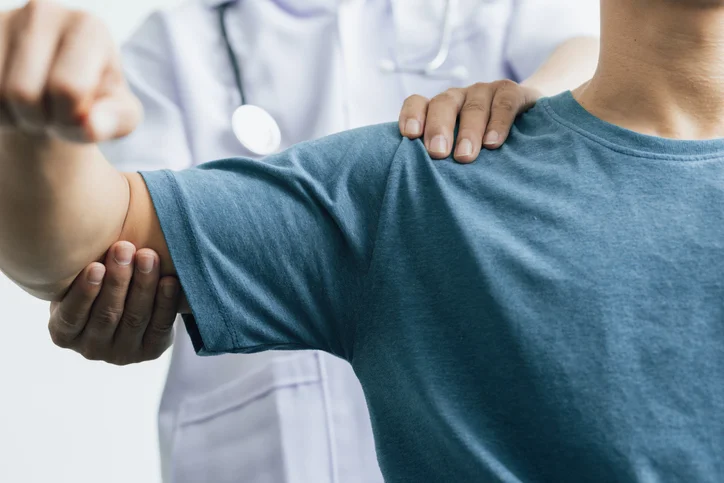
A slip at my home proved fateful, resulting in a comminuted left shoulder clavicle fracture. “It’s nothing,” they would tell me, “it will knit.” However, this was not the case. The clavicle, as I later learned, cannot be repositioned without surgical intervention and treatment with a figure-of-eight bandage for 2.5 months.
The pains were unbearable. Three months later, the problem was much more serious than they had described it to me. As time went by, I could feel the clavicle bone floating internally. I would lift my arm and feel a rotation of the bone that had been cut in half.
How serious can a clavicle fracture be?
A clavicle fracture is a break (crack) in the collarbone, which constitutes one of the main bones of the shoulder. The clavicle is the only connecting bone between the torso and the upper limb. My fracture was caused by a fall.
Why should we seek medical help immediately?
Seeking medical help in this case is imperative, as a clavicle fracture is a very painful injury. In my case, apart from the intense pain, I faced a shoulder deformity, since my shoulder had lost its symmetry by 3.5 cm, as well as stiffness, meaning difficulty in moving and lifting the limb, accompanied by a sensation of crepitus.
When almost 4 months had already passed, I looked for an orthopedic surgeon who specializes in the upper limbs. Dr. Ioannis Polyzois was my choice due to his specialization. I searched for him online, without recommendations, and after reading his resume, I contacted him.
From the very beginning, I not only realized that he possesses deep knowledge and experience from similar cases, but I also felt immediate comfort and safety thanks to his approachable character. Also, I would like to note that I reside in Crete. Therefore, our meeting required extra organization. Even in this, however, he was very supportive of the appointment I requested.
After the clinical examination and the evaluation of the shoulder X-ray I had already done, and since the bone comminution involved a displacement (>2 centimeters) of the fracture fragments, Dr. Polyzois did not doubt that conservative treatment was not suitable for my case and that surgery using the osteosynthesis method was the ideal solution.
When you hear the word “surgery”, you definitely get stressed. Many are those who think of ways to avoid it. Although I belong to the category of people who want to avoid surgery, I did not think twice about it at all, as I had visited 4 orthopedic surgeons beforehand with zero results, and the solution offered to me by Dr. Polyzois was a deliverance. My case was quite urgent, as I had already been delayed, so the operation was scheduled quite promptly.
How did I experience the surgery and the postoperative period as a patient?
Fortunately, in my misfortune, I was also “lucky” as the fracture had formed a nonunion (pseudoarthrosis) and the bone did not need to be broken again to be placed in its proper position. Dr. Polyzois was very supportive, both before and after the surgery, and made me feel calm and secure.
The surgery lasted 1.5 hours under general anesthesia with a very fast recovery. In 3 hours, they brought me food and coffee! I was discharged the same day and traveled to Crete the very next day! Dr. Polyzois was always available to answer any question or concern of mine during recovery, which led me to the conclusion that he genuinely cares about each of his patients.
The postoperative course was not particularly difficult. The first days after surgery were a challenge, mainly due to the stitches; painkillers were not particularly needed beyond the usual ones. I needed to wear a sling for 4 weeks, but movement below the shoulder level was a key prerequisite from the very first postoperative day. The stitches, one on the right, one on the left, were removed after two weeks. Movements up to 4 weeks were made gradually with caution and always in consultation with Dr. Polyzois. At 3 months, we met again for a re-examination, and I started physical therapy.
What did I learn? After surgery, the patient also plays a key role.
It is important that after surgery, the patient is not afraid and has no insecurity about moving their arm. Dr. Polyzois advised me to start physical therapy, but without excesses. My bone is now in very good condition; I can lift almost the same weight as with my other arm, the sensation of crepitus has disappeared, and the absolute symmetry of my shoulders has returned to its normal level.
The physical therapy went very well, but let me note that thalassotherapy (sea therapy) is the ultimate medicine for this type of fracture. Without, however, the correct judgment and very good work that Dr. Polyzois did in the operating room, none of this would have been feasible.
I thank him warmly! May he always be well!