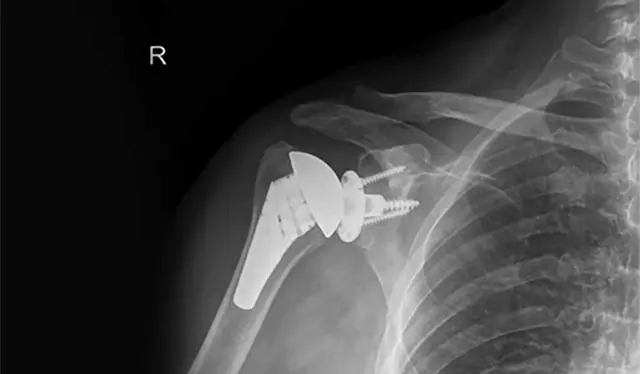
Total Shoulder Arthroplasty

ΠΕΡΙΕΧΟΜΕΝΑ

The shoulder joint is a biomechanical marvel. It allows us to reach high, to embrace, to play sports, and to perform the most complex daily activities. However, when this joint is destroyed by the progressive wear of arthritis or by serious injuries, every simple movement is transformed into a daily, exhausting struggle. Total Shoulder Arthroplasty constitutes one of the greatest and most revolutionary achievements of modern orthopaedic surgery, offering a definitive solution where medication and conservative treatments fail.

As a scientist and doctor, my approach to medical practice is deeply research-based and realistic. I am sceptical of “magical solutions” and I do not rely on the first glance at a simple X-ray. I know that neither I, nor any doctor possesses infallibility, but what distinguishes us is the continuous, persistent effort towards absolute accuracy. I double-check every examination, study the data in depth, and always pursue the scientifically documented result.

The purpose of this extensive, analytical guide is to provide you with every possible piece of information about Total Shoulder Arthroplasty. We will examine together, with absolute transparency, how the operation works, which conditions make it necessary, what exactly happens in the operating theatre, and how we plan your return to a life full of strength and, most importantly, free of pain.

The Biomechanics and Anatomy of the Shoulder

To grasp the value of replacing a joint, one must first understand its complexity. The glenohumeral joint (the main shoulder) resembles a ball resting in a shallow socket.

  • The Ball: It is the head of the humerus (the long bone of the arm).
  • The Socket: It is called the glenoid and forms part of the scapula.

In a healthy shoulder, these two bony surfaces are covered by articular cartilage, a smooth, white, slippery tissue that allows the bones to glide over one another with absolutely no friction. The joint is surrounded by the joint capsule, which produces the synovial fluid, functioning as the natural lubricant of the area. At the same time, the rotator cuff (a set of four strong tendons) keeps the ball stably centred within the socket.

When this perfect system collapses, the smooth cartilage disappears. The bones rub directly against each other (bone-on-bone), creating osteophytes (“spurs”), deformities, unbearable pain, and extreme stiffness. This is the moment when total shoulder arthroplasty comes into action.

What is Total Shoulder Arthroplasty?

In simple terms, it is the surgical replacement of the worn, damaged articular surfaces of the shoulder with extremely advanced, specially designed artificial implants. These implants (prostheses) are made of materials of the highest durability, such as alloys of titanium, cobalt-chromium, and ultra-resistant polyethylene (special plastic), which are 100% biocompatible with the human body.

The goal is not merely to mask the pain, but to restore the anatomy. We replace the damaged ball of the bone with a smooth metal one, and the worn glenoid with a durable plastic insert, creating a brand-new, mechanically flawless joint.

Ο μόνος Ορθοπαιδικός στην Ελλάδα στην χειρουργική ώμου και άνω άκρου με προϋπηρεσία μόνιμης διευθυντικής θέσης (substantive Consultant ) για 10 συναπτά έτη στην Μεγάλη Βρετανία

Which Conditions Are Treated with the Operation?

Not all shoulder pain leads to surgery. Total arthroplasty is the treatment of choice for specific, serious pathological conditions that destroy the cartilage:

Osteoarthritis of the Shoulder (Degenerative Arthritis)

This is the most common cause. It is the progressive wear and tear of the joint, closely related to age (usually in people over 50 years of age), genetic predisposition, and chronic overuse. The cartilage thins, cracks, and eventually disappears. Without the protective cushion, the humeral bone rubs against the scapula. The body, in its attempt to react, creates bony protrusions (osteophytes), which dramatically restrict movement and cause intense “creaking”.

Rheumatoid Arthritis and Chronic Inflammatory Arthritides

In contrast to osteoarthritis, which is mechanical wear, rheumatoid arthritis is an autoimmune disease. The patient’s own immune system becomes “confused” and attacks the joint capsule. The capsule becomes inflamed, swollen, and produces chemical substances that literally “eat away at” and dissolve the articular cartilage and the underlying bone. It often affects both shoulders and leads to rapid deformation of the joint.

Post-traumatic Arthritis

It appears after a serious injury to the shoulder, such as a comminuted fracture (break) or multiple dislocations that occurred in the past, even years before. The trauma disrupts the perfect alignment and smoothness of the cartilage. Even if the fracture “sets” correctly, the wear has already begun, leading prematurely to a destructive form of arthritis.

Avascular Necrosis of the Head of the Humerus

A painful condition where the blood supply to the head of the bone is interrupted (due to the use of cortisone in high doses, alcoholism, diving, or severe fractures). Without blood, the bone literally “dies”, loses its hardness, crumbles, and collapses.

Indications: When is Surgery the Only Solution?

The decision for surgery is not taken lightly. As a doctor who relies on scientific data, I proceed to a recommendation for arthroplasty when the symptoms deprive the patient of the fundamental right to quality of life.

The main indications include:

  • Intense Pain in Daily Life: When the pain prevents simple, daily routine movements, such as getting dressed, combing the hair, reaching for an object on a shelf, or even feeding oneself.
  • Distressing Nocturnal Pain: When you cannot sleep because the shoulder hurts, regardless of your body position, resulting in chronic insomnia and exhaustion.
  • Severe Stiffness: When you perceive a progressive inability to move, as if the shoulder has “locked”, and you feel or hear a characteristic friction sound (crepitus) within the joint.
  • Failure of Conservative Treatment: When strong anti-inflammatory drugs, intra-articular injections (cortisone or hyaluronic acid), and many months of physiotherapy programmes no longer offer any relief.

Preoperative Assessment and the Value of Precise Planning

Here, my philosophy is put to the test: We leave nothing to chance. The clinical examination is the cornerstone. I listen carefully to your history and examine the range of motion and the strength of your muscles.

But we do not stop there. To proceed to arthroplasty, the imaging assessment must be exhaustive. Simple X-rays show the loss of the space between the bones (the signs of arthritis), but a Three-Dimensional Computed Tomography (3D CT Scan) is necessary. Using specialised computer programmes, we reconstruct your shoulder in a 3D model. This allows me to measure the angles with millimetric accuracy, to identify bone wear in the scapula, and to pre-select the exact size and inclination of the implant before we even enter the operating theatre.

Magnetic Resonance Imaging (MRI) is often also requested to check whether the tendons of the rotator cuff are intact or torn, as this detail determines the type of arthroplasty we will choose.

The Types of Total Shoulder Arthroplasty

Modern orthopaedics does not apply the same solution to everyone. We distinguish three main categories of arthroplasties, depending on the anatomy and the condition of the patient:

Anatomic Total Shoulder Arthroplasty

In this case, we preserve the normal anatomy. The worn head is replaced with a smooth metal ball (which is supported on a metal stem within the bone), and the glenoid is replaced with a special, ultra-smooth plastic insert made of polyethylene. The basic prerequisite for this method to succeed is that the tendons of the rotator cuff are healthy and intact, so that they can function as the stabilisers and motors of the new joint.

Hemiarthroplasty

As its name suggests, we replace only half of the joint. We remove the damaged head of the humerus and place the metal implant, but we leave your own normal glenoid intact (the socket of the scapula). It is usually applied in young patients with avascular necrosis (where the glenoid is healthy) or in certain complex four-part fractures of the humerus.

Reverse Total Shoulder Arthroplasty

This is a biomechanical leap. It is used when the patient has severe arthritis, at the same time, the tendons of the rotator cuff are destroyed or torn (rotator cuff tear arthropathy). Here, the anatomy is reversed: The artificial ball is screwed into the socket of the scapula, and the artificial concave insert is placed on the humerus. By changing this centre of rotation, the shoulder can now be lifted using the external deltoid muscle exclusively, offering excellent results in patients who would otherwise remain paralysed.

The Procedure of the Operation: What Happens in the Operating Theatre?

Entering the operating theatre, our team is already absolutely prepared. The operation is performed under general anaesthesia, which is almost always combined with regional anaesthesia (interscalene block). Our specialised anaesthesiologist “numbs” the nerves of the shoulder, which guarantees that the patient will not feel the slightest postoperative pain for at least 12 to 24 hours.

The procedure usually lasts around 90 minutes:

  • Approach: We use techniques with as small an incision as possible (deltopectoral approach), respecting the tissues completely. The basic muscles are not cut, but pushed aside (opened like a curtain) to expose the joint.
  • Bone Preparation: We remove the large, painful osteophytes and the deformed portion of the joint surface, preparing the healthy bone to receive the prosthesis.
  • Placement of Materials: We insert and secure the 100% biocompatible implants. Their stabilisation can be achieved with the use of special medical cement or with the “biological integration” method (press-fit), where the patient’s own bone embraces and “grows” onto the micro-porous metal of the prosthesis.
  • Check and Closure: I thoroughly check the reduction, the stability, and the range of motion of the new joint. When I confirm the perfect biomechanical function, the wound is closed carefully, ensuring an excellent aesthetic result.

Shoulder Arthroplasty: Recovery and Physiotherapy After Surgery

The operation is only the first step. To ensure the optimal result, recovery and physiotherapy are non-negotiable factors.

Usually, the patient remains in the clinic for 1 to 2 days, exclusively for monitoring and the administration of intravenous analgesia and antibiotic cover.

  • The First 3–4 Weeks: Your arm will rest in a special sling. However, mobilisation begins immediately! From the very first day, you will move your fingers, your wrist, and your elbow, and you will perform special passive exercises (pendulum exercises) so that the shoulder does not “freeze”.
  • 1st to 2nd Month: The personalised physiotherapy programme begins. The goal now is the gradual recovery of the range of motion, with the sling completely removed. You can take care of yourself (eat, dress).
  • 3rd Month and Onwards: The emphasis shifts to the strengthening of the muscles. The muscles of the shoulder had atrophied due to the chronic pain, and now they “learn again” to support your new joint. The return to full, dynamic activity (even to sports such as swimming or tennis) is usually established at 4–6 months.

Possible Complications and Their Prevention

In modern medicine, honesty towards the patient is a fundamental principle. Although Total Shoulder Arthroplasty is one of the safest and most successful operations, it remains a major surgery. The frequency of complications is minimal (it ranges around 5% internationally), and knowledge is power.

The possible complications are always manageable and include:

  • Infections: To eliminate the risk, the operation is performed under conditions of absolute sterility (ultra-clean operating theatres) and prophylactic antibiotic therapy is administered.
  • Instability or Dislocation: The artificial joint may dislocate if the patient makes extreme, forbidden movements too early in the recovery. Compliance with our instructions is critical.
  • Nerve Injury: The nerves around the shoulder are sensitive. A transient numbness is rare but real, which, however, in most cases, resolves automatically.
  • Mechanical Loosening of Materials: After many years (15–20 years), the materials may wear and need replacement (revision).

Cost and Price: An Investment in Quality of Life

The return to a pain-free, normal life is priceless, but the practical issue of the cost of the operation rightly concerns every patient. There are no uniform, “standardised” prices, as medicine does not operate in this way.

The final cost of the Total Shoulder Arthroplasty is shaped by a series of important parameters. It depends directly on the type of implant required (Anatomic or Reverse, each of which has a completely different industrial cost), on the cutting-edge materials we order in a personalised way for you from top international manufacturers (USA, Switzerland), as well as on the days of hospitalisation in the chosen clinic. The insurance coverage you have (EOPYY or Private Insurance Company) also plays an important role.

For these reasons exactly, accurate, transparent, and honest information about the cost of your particular case can be given exclusively following a clinical examination. At our appointment, we will study your examinations, choose the appropriate method, and present you with a clear, detailed quotation without any hidden charges.

Meet the Doctor: Dr. Ioannis Polyzois

The replacement of a joint is an operation of absolute precision, where the experience of the surgeon determines the viability of the result. As an Orthopaedic Surgeon with absolute specialisation in the conditions, complex trauma, and arthroplasties of the shoulder and upper limb, my primary goal is to offer you a safe and definitive solution.

Having served as a permanent Consultant in Orthopaedics in the National Health Service of Great Britain (NHS) for more than 10 years, I was trained in an environment that demands excellent documentation and strict safety protocols. My extensive further training at the largest centres of reconstructive surgery worldwide enables me to apply the most modern international techniques (such as 3D Preoperative Planning) in Greece.

To date, I have performed more than 9,000 surgical operations, and I possess specialised experience in the placement of hundreds of arthroplasties. This vast surgical experience makes me competent for the successful execution of such high-difficulty operations. Every patient is unique, which is why my approach is always entirely personalised. I am here to listen to your problem with attention and, together, to plan your return to a daily life without any trace of pain.

Movement is life!

Arthritic pain and stiffness should not constitute the “new reality” to which you must resign yourself. Modern orthopaedics provides absolutely safe and permanent solutions. Contact our practice today to schedule a diagnostic appointment. We will analyse your examinations in detail, I will answer every question of yours with scientific honesty, and together we will design your own, fully tailored treatment to get your life back.

Η κIνηση εIναι ζωH!

Επικοινωνήστε με τον γιατρό για εξειδικευμένη ορθοπαιδική φροντίδα, προσαρμοσμένη στις ανάγκες σας

Συχνές ερωτήσεις

When is the operation truly necessary?

The operation becomes necessary when the pain is constant (even at rest or in sleep), when the stiffness prevents you from performing basic self-care movements, and most importantly, when the entire range of conservative methods (physiotherapy, strong painkillers, injections of hyaluronic acid/cortisone) has definitively ceased to relieve you. It is an operation of quality of life.

When can I drive after the operation?

Driving requires immediate reflexes and the use of both hands on the steering wheel, without pain. In general, return to driving is permitted approximately 6 weeks after the operation, when the sling has been completely removed, you have recovered sufficient muscular control, and you are no longer taking strong analgesic drugs.

When can I sleep normally after shoulder arthroplasty?

For the first 4 to 6 weeks, sleeping on the operated shoulder is forbidden. You will need to sleep on your back, perhaps in a slightly raised (semi-sitting) position with the help of pillows. After the 6th week, as the internal tissues heal, you will be able to sleep in any position you wish without discomfort.

How long do the implants of shoulder arthroplasty last?

The latest-generation materials (special titanium alloys and cross-linked polyethylene) are made to withstand enormous stresses. In the overwhelming majority of patients (over 85–90%), the implants remain in excellent functional condition for more than 15 to 20 years. The lifespan depends, of course, also on the level of the patient’s activity.

How intense will the pain be immediately after the operation?

Thanks to the advanced regional anaesthesia (nerve block) that we apply, most patients wake from the operation feeling absolutely no pain in their shoulder for the first 24 hours. When the action of the local anaesthesia begins to subside, the pain is controlled extremely effectively with a combination of modern oral painkillers, so that you are comfortable and ready to begin physiotherapy.

Will I be able to lift weights after the rehabilitation?

Yes, you will be able to lift the weights required for all your normal daily activities (e.g. supermarket shopping, suitcases, household work). However, extreme weights (e.g. weightlifting in the gym) or professions that require continuous, heavy manual work with impact tools should be avoided in order to prevent premature wear or loosening of the implant over time.

When will I be able to return to my work?

It depends exclusively on the type of your work. If you do office work (computer), return is usually feasible in 3 to 4 weeks. If your work is a light manual, count on 2 months. If it requires intense physical effort, 3 to 4 months of full recovery may be needed.

Is there an age limit for shoulder arthroplasty?

There is no strict age limit. We have operated with great success on patients aged 80 and 85. The criterion is not the biological age, but the level of general health (so that the patient can safely receive general anaesthesia) and, of course, the will of the patient to be relieved of pain and to live a dignified life.

Will I set off the airport security machines?

Due to the quantity of metal in the prosthesis (titanium or cobalt), it is quite likely that you will activate the sensitive metal detectors at airports. For this reason, we provide you postoperatively with a special, signed medical certificate, which you can show to the security authorities, immediately resolving any issue.